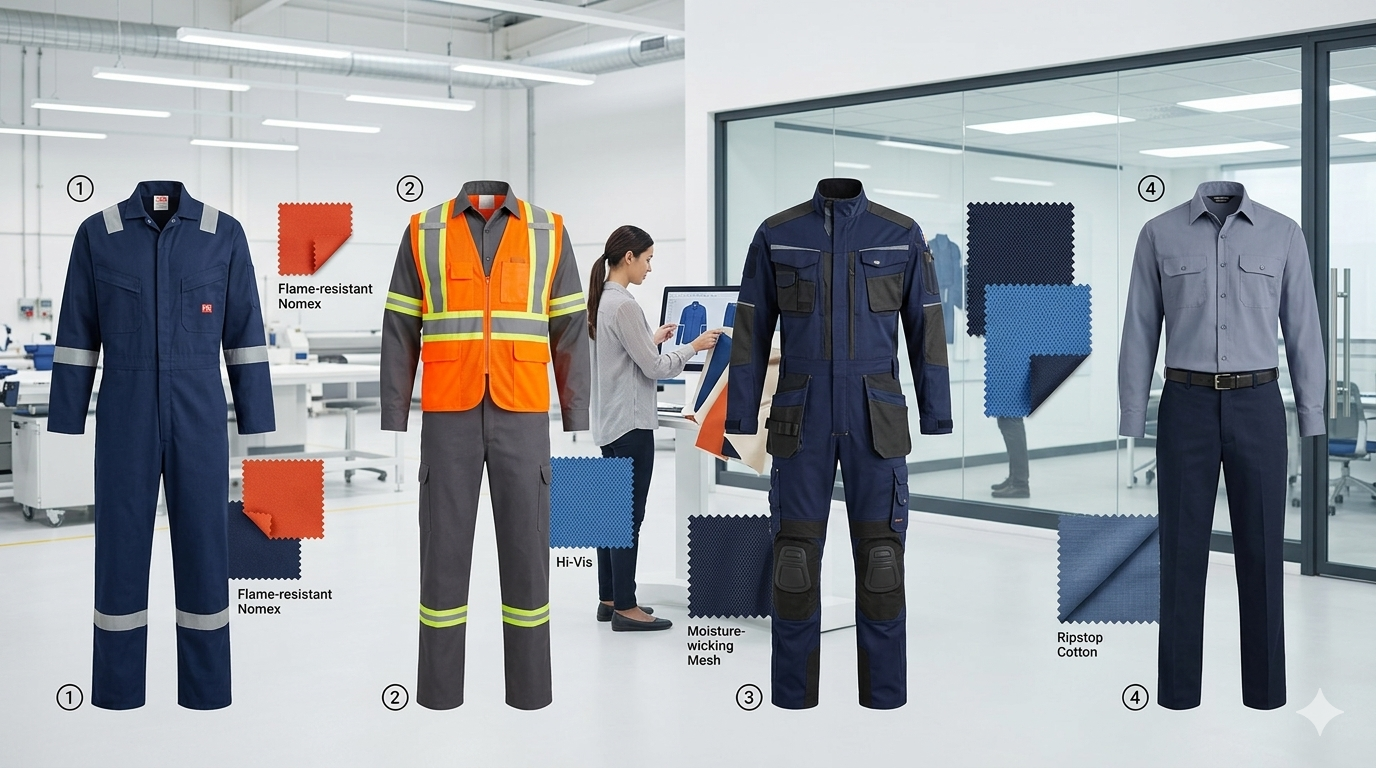
7 Things to Consider Before Ordering Corporate Uniforms in Bulk
Corporate uniforms do more than give employees a consistent appearance. They can influence how customers perceive a company, how employees represent the brand, and even how professional a workplace feels. Whether you are ordering uniforms for a small team or outfitting hundreds of employees across multiple locations, getting the decision right before placing a bulk order can save considerable time, money, and frustration.
Ordering corporate uniforms in bulk is also very different from purchasing a few individual garments. Fabric quality, sizing, branding, employee comfort, delivery schedules, customization, and long-term durability all become important when dozens or hundreds of people will be wearing the same clothing.
A uniform that looks impressive in a catalogue may not necessarily be practical for employees who wear it eight or nine hours a day. Similarly, choosing the cheapest option may seem like a smart way to control costs, but poor-quality uniforms can fade, shrink, lose their shape, or require frequent replacement.
Before you finalize your order, consider these seven important factors.
1. Choose the Right Fabric and Material
Fabric is one of the most important decisions when ordering corporate uniforms. Employees may spend most of their working day wearing the uniform, so comfort should not be treated as an afterthought.
The ideal fabric depends largely on the working environment, climate, and nature of the job.
For office employees working in air-conditioned environments, materials such as cotton blends, polyester-viscose fabrics, or premium formal suiting materials may work well. For employees working outdoors or in warmer conditions, breathable and lightweight fabrics can make a significant difference.
In countries with hot and humid weather, including India, fabric selection becomes particularly important. Heavy materials may look formal but can quickly become uncomfortable during long working hours.
Consider factors such as:
- Breathability
- Weight of the fabric
- Sweat absorption
- Stretch and flexibility
- Colour retention
- Resistance to wrinkles
- Ease of washing
- Shrinkage after washing
- Overall durability
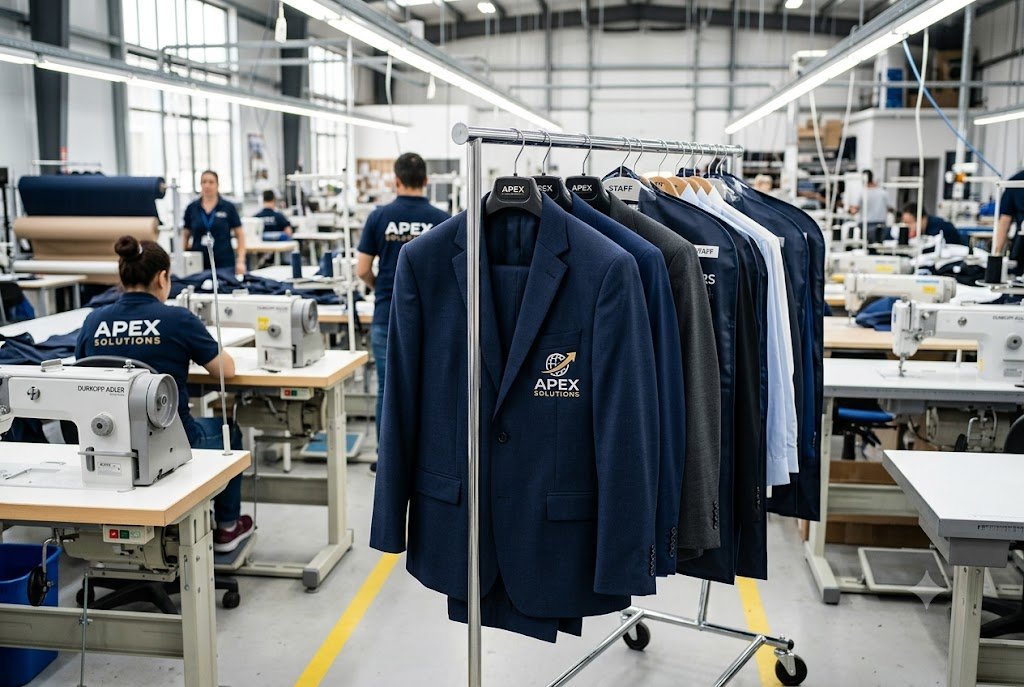
For example, a hotel employee who spends hours moving between different areas of a property may need a different fabric from an executive who primarily works at a desk.
It is also worth requesting fabric samples before placing a large order. A small swatch can tell you about texture, thickness, colour, and overall quality far better than a photograph.
Never evaluate corporate uniforms based on appearance alone. Think about how the fabric will perform after repeated washing and regular use.
2. Prioritize Employee Comfort
A corporate uniform represents the company, but employees are the people who have to wear it every day.
An uncomfortable uniform can lead to complaints, poor morale, and employees altering the clothing themselves. If the uniform is too tight, too heavy, too warm, or restrictive around the shoulders and arms, employees may struggle to perform their jobs comfortably.
This is particularly important for industries where employees are constantly moving.
For example, uniforms for hospitality staff, healthcare workers, delivery teams, retail employees, security personnel, technicians, and field representatives should allow sufficient freedom of movement.
Before finalizing a design, consider conducting a small employee trial. Select people with different body types and ask them to wear sample uniforms during a normal working day.
Ask practical questions:
- Is the uniform comfortable after several hours?
- Can employees move easily?
- Does the fabric feel too warm?
- Are the buttons, zippers, or pockets positioned properly?
- Is the collar comfortable?
- Does the uniform fit different body shapes?
- Can employees perform their regular tasks without restrictions?
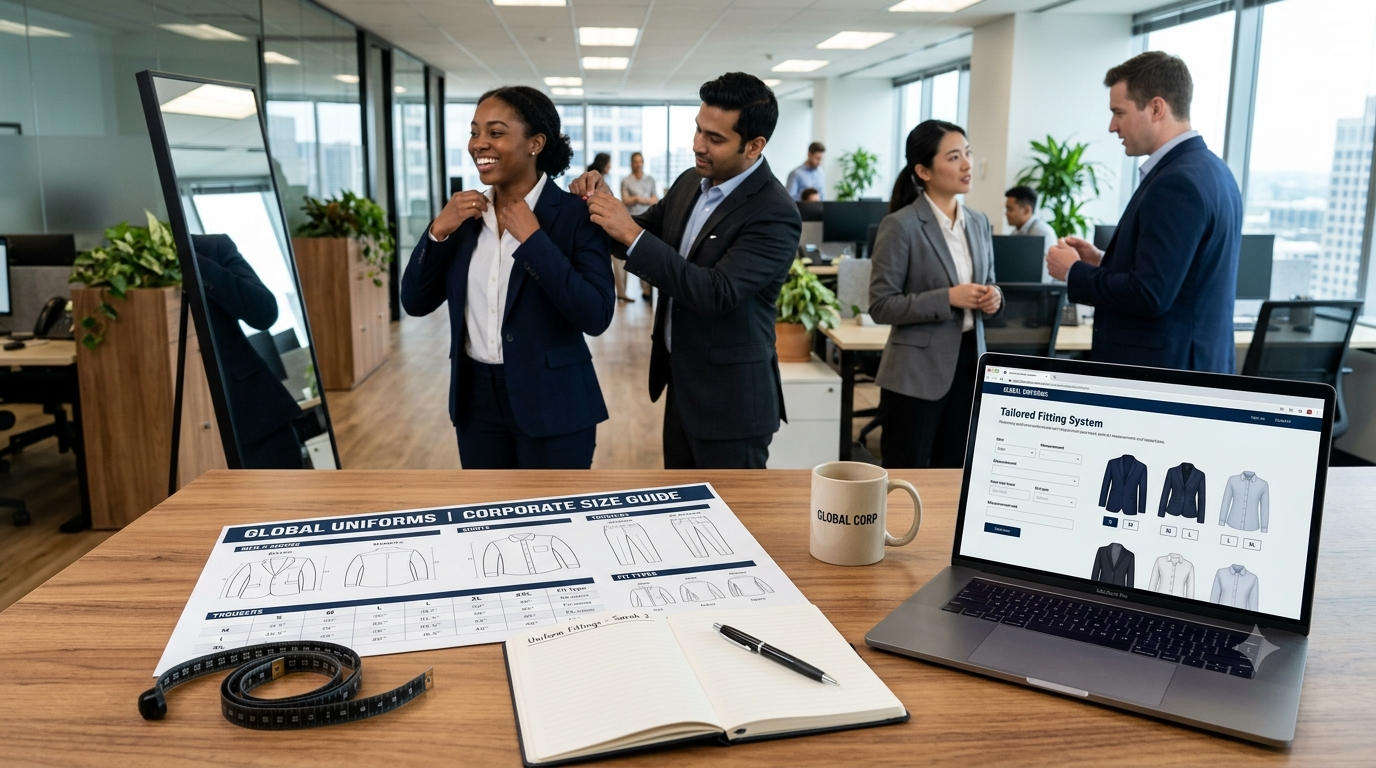
Employee feedback at this stage can prevent expensive mistakes later.
Remember, a successful corporate uniform should balance appearance and comfort. A uniform that looks excellent but is uncomfortable will rarely be appreciated by the people wearing it.
3. Get the Sizing and Fit Right
Sizing becomes surprisingly complicated when you are ordering uniforms for an entire organization.
Employees naturally have different body shapes and proportions. Simply asking everyone to select Small, Medium, Large, or Extra Large may result in inconsistent fits.
This is why businesses should establish a proper corporate uniform size chart before placing the final order.
Instead of relying only on standard clothing sizes, consider measurements such as:
- Chest
- Waist
- Hip
- Shoulder width
- Sleeve length
- Shirt length
- Trouser length
- Inseam
The supplier should ideally provide a detailed size chart and, when possible, physical samples for employees to try.
It is also important to separate men’s and women’s sizing where appropriate. Women’s uniforms often require different cuts around the waist, bust, hips, and shoulders rather than simply using smaller versions of men’s garments.
For large companies, organizing a uniform sizing day can be extremely useful. Employees can try sample garments and provide their measurements before the final production begins.
Keep a record of each employee’s selected size and required alterations. This reduces confusion when the order is delivered.
You should also consider future employees. If your company regularly hires new staff, ask the supplier whether they can maintain the same fabric, colour, design, and specifications for smaller repeat orders.
This matters because corporate uniforms are rarely a one-time purchase. Companies often need replacements, additional sizes, or uniforms for newly hired employees.
4. Make Branding Part of the Design
One of the biggest advantages of corporate uniforms is their ability to reinforce brand identity.
A well-designed uniform can turn employees into walking representatives of your business. Customers can immediately identify staff members, while the company’s colours and logo become more visible in everyday interactions.
However, branding should be subtle and professional rather than excessive.
Common customization options include:
- Embroidered company logos
- Printed logos
- Employee names
- Department names
- Company taglines
- Custom buttons
- Branded labels
- Custom colour combinations
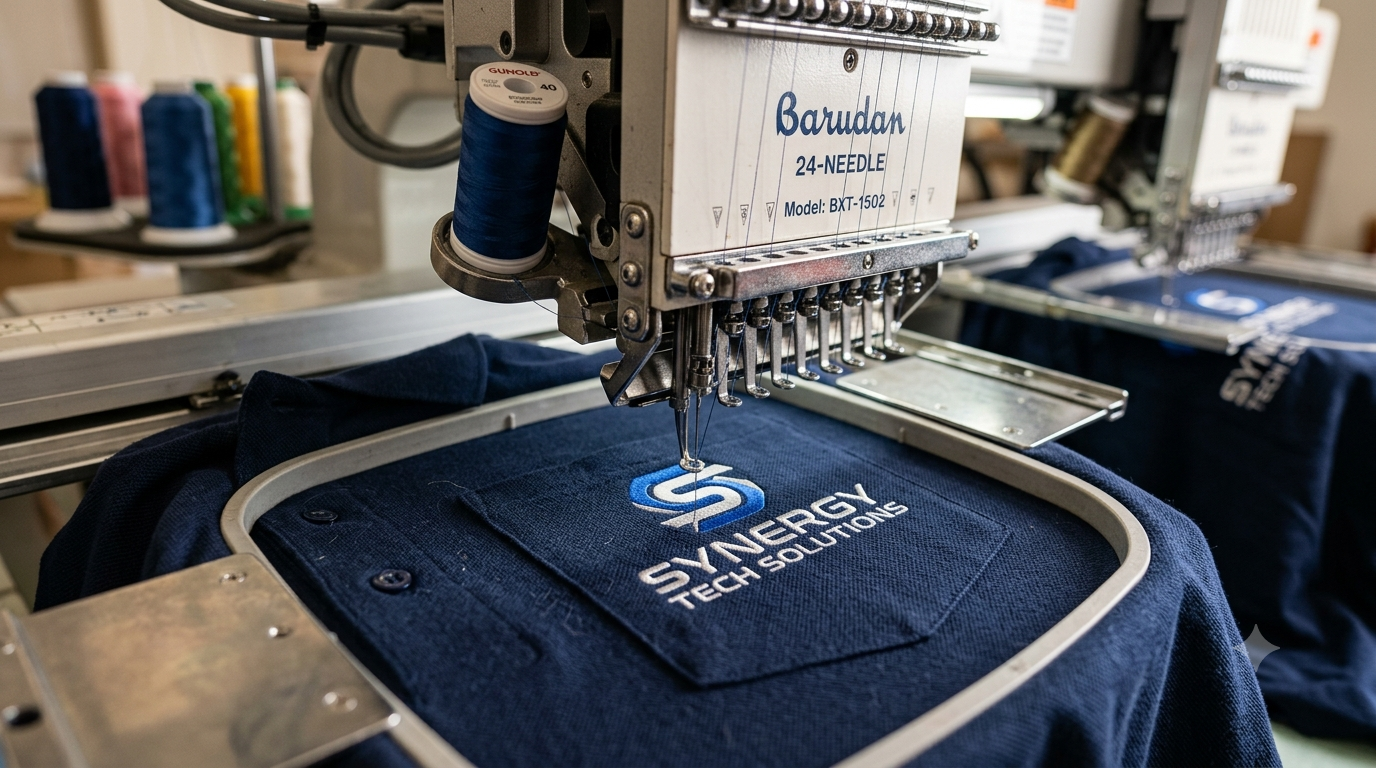
For most professional uniforms, embroidery is a popular choice because it creates a premium appearance and can withstand repeated washing.
Placement also matters. A company logo is commonly positioned on the left chest, sleeve, or upper back, depending on the garment.
Think carefully about logo size. An oversized logo may make a formal uniform look more like promotional merchandise, while a logo that is too small may not be noticeable.
Your brand colours should also be reproduced accurately. Ask the uniform supplier whether they can match your approved brand colours and provide a sample before mass production.
If your company has established brand guidelines, provide the supplier with the correct logo files and colour specifications.
The goal should be simple: the uniform should look unmistakably like your company’s uniform without sacrificing professional design.
5. Calculate the Total Cost, Not Just the Per-Uniform Price
Price is obviously an important consideration when ordering corporate uniforms in bulk, but the cheapest quotation isn’t necessarily the most economical option.
Suppose Supplier A offers a uniform for ₹700 while Supplier B charges ₹950. At first glance, Supplier A appears to be the obvious choice.
But what happens if Supplier A uses lower-quality fabric that fades within a few months and needs replacement twice as often?
The actual cost may end up being significantly higher.
When comparing quotations, look beyond the basic garment price. Ask what is included.
Your total cost may involve:
- Fabric
- Stitching
- Embroidery
- Printing
- Buttons and accessories
- Packaging
- Alterations
- Shipping
- Taxes
- Sampling
- Additional sizing
- Future replacement orders
You should also ask about minimum order quantities.
Some suppliers may offer attractive pricing only when you purchase a large number of uniforms. Others may allow smaller repeat orders at a slightly higher unit price.
For larger organizations, it can be useful to calculate the total cost of ownership.
For example:
Initial uniform cost + customization + maintenance + expected replacement cost = actual uniform investment
A slightly more expensive uniform that lasts twice as long may provide better value than a cheaper garment that needs frequent replacement.
6. Check Quality, Stitching, and Durability
A corporate uniform can look perfect when it is brand new. The real test comes after weeks and months of use.
This is why quality inspection should happen before you place a bulk order.
Request a sample or prototype from the supplier. Examine the stitching, seams, buttons, zippers, collars, cuffs, pockets, and embroidery.
Pay particular attention to areas that experience frequent stress.
For shirts, inspect the collar, sleeve seams, buttons, and side seams. For trousers, look at the waistband, pockets, zipper, and inner seams.
You should also consider how the uniform behaves after washing.
Ask the supplier:
- Does the fabric shrink?
- Is the colour resistant to fading?
- Can it be machine washed?
- Does it require ironing?
- How should it be dry-cleaned?
- How many washes is the garment expected to withstand?
- Is colour consistency maintained across different production batches?
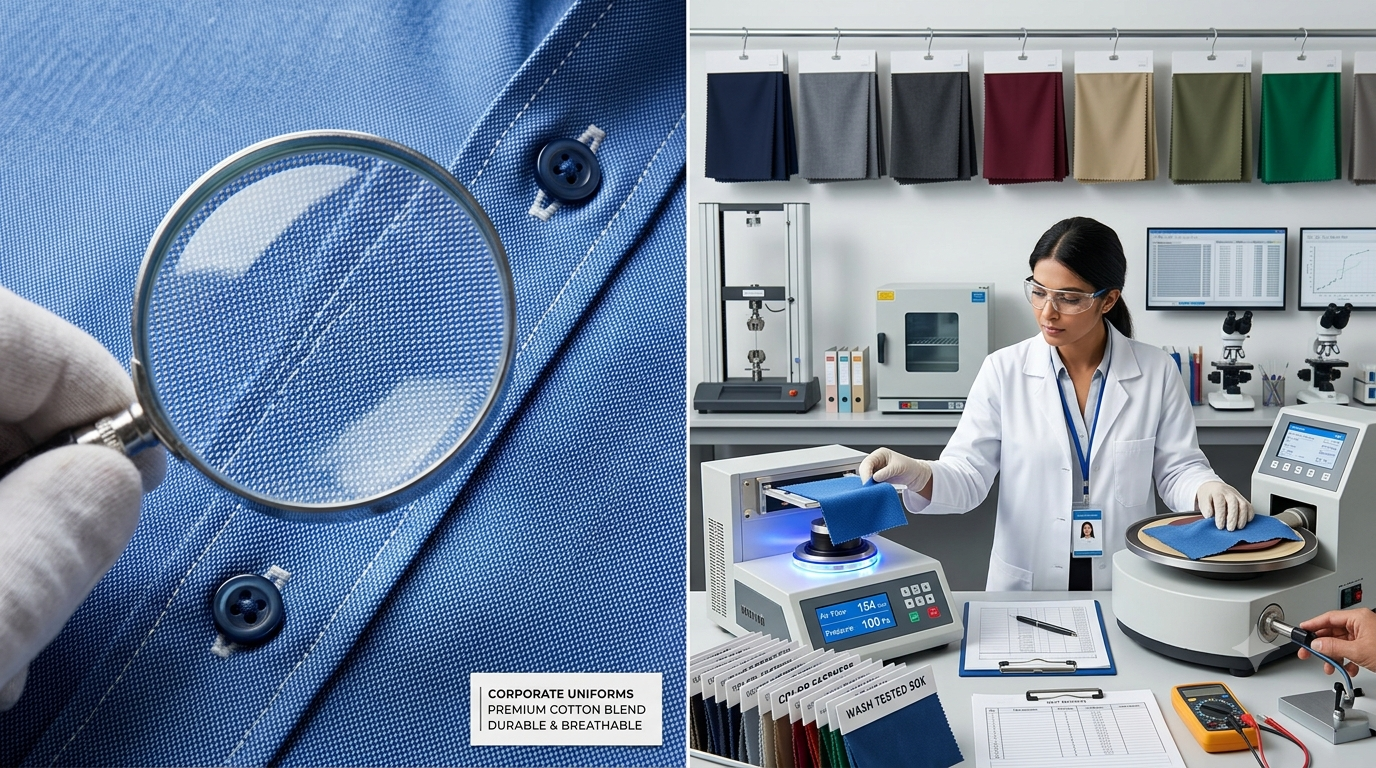
If possible, wash and test a sample before approving the bulk order.
This is especially important when ordering uniforms in large quantities because a small manufacturing problem can become a major issue when multiplied across hundreds of garments.
For example, if a particular colour is slightly different from your approved sample, receiving 500 uniforms in that shade can create a costly problem.
Quality control before production is considerably easier than fixing a large defective order afterward.
7. Plan Production and Delivery Well in Advance
Timing is often overlooked when businesses order corporate uniforms.
Bulk uniform manufacturing can take considerably longer than buying ready-made clothing. Custom fabric, embroidery, printing, sizing, stitching, quality checks, packaging, and shipping all require time.
If uniforms are needed for a new office opening, company event, employee onboarding, or rebranding exercise, don’t wait until the last minute.
Discuss the complete production timeline with your supplier before confirming the order.
A typical process may include:
Design → Fabric selection → Sample → Approval → Employee sizing → Production → Quality inspection → Packaging → Delivery
Each stage can introduce delays.
For large orders, ask the supplier to confirm:
- Sample approval date
- Production start date
- Expected completion date
- Quality-check timeline
- Dispatch date
- Estimated delivery date
- Process for handling defective pieces
It is also sensible to keep some extra uniforms in stock.
Employees may join the company after the original order, existing uniforms may become damaged, or certain sizes may become unavailable. Keeping a small buffer can prevent the need for urgent small-batch orders.
If your business operates across several branches, establish a system for distributing and replacing uniforms. This makes future orders much easier to manage.
Why Choosing the Right Uniform Supplier Matters
The supplier you choose can have just as much impact as the uniform design itself.
A professional corporate uniform manufacturer should be able to handle your requirements consistently, particularly when dealing with large quantities.
Look for a supplier with experience in bulk corporate clothing and ask for samples of previous work.
Before selecting a supplier, consider:
- Experience with corporate clients
- Fabric options
- Customization capabilities
- Minimum order quantity
- Production capacity
- Quality-control process
- Delivery reliability
- Replacement policy
- Communication and support
- Ability to handle repeat orders
Don’t hesitate to ask detailed questions. A reliable supplier should be comfortable discussing fabric specifications, measurements, production timelines, customization, and quality standards.
If you are ordering uniforms for a growing company, also think beyond your first order. You may need the same design again six months or one year later. Consistency becomes much easier when you work with a supplier who keeps proper records of your specifications.
A Simple Checklist Before Placing Your Bulk Uniform Order
Before giving final approval, review the following checklist:
Design : Does the uniform reflect your brand? Is it suitable for the employees’ roles? Does it look professional?
Fabric : Is it comfortable? Is it suitable for your climate? Can it withstand frequent washing?
Sizing : Has everyone provided accurate measurements? Are men’s and women’s fits appropriate? Have sample sizes been tested?
Branding : Is the logo correctly positioned? Are brand colours accurate? Has embroidery or printing been tested?
Cost : Does the quotation include customization and delivery? Have you considered long-term replacement costs? Are there additional charges?
Quality : Have you approved a physical sample? Have stitching and finishing been inspected?
Has the sample been washed and tested?
Delivery : Is the production schedule realistic? Is there enough time for quality inspection? Have you planned extra stock?
Taking a few extra days to review these details can save weeks of problems later.
Why Choosing the Right Corporate Uniform Supplier Matters
Choosing the right supplier can be just as important as choosing the right uniform design. A reliable supplier should be able to maintain consistency in fabric, colour, sizing, branding, stitching, and finishing across a large order.
This becomes particularly important when you’re ordering uniforms for multiple departments, branches, or hundreds of employees. Even a small variation in colour or sizing can become noticeable when an entire workforce is wearing the same uniform.
Before selecting a supplier, look for:
- Experience in manufacturing corporate uniforms
- Custom fabric and design options
- Reliable embroidery and logo printing
- Clear sizing and sampling procedures
- Consistent quality across bulk orders
- Transparent pricing
- Reliable delivery timelines
- Support for repeat and replacement orders
For businesses looking for a dedicated corporate uniform manufacturer, Atlas Infiniti offers customized corporate wear designed around different workplace requirements. Its range includes custom shirts, T-shirts, blazers, men’s office uniforms, ladies’ office uniforms, jackets, caps, and custom logo bags. The company also highlights customization, bulk-order capabilities and Pan-India delivery as part of its service offering.
The advantage of working with a specialist is that your uniform requirements can be considered as a complete package rather than simply purchasing ready-made garments. Fabric selection, brand colours, logo placement, employee comfort and the intended use of the uniform can all be discussed before production.
For a growing organization, it is also worth asking whether the supplier can support future requirements. New employees, replacements and additional departments may require smaller repeat orders while maintaining the same design and specifications.
Final Thoughts
Ordering corporate uniforms in bulk is an investment in more than employee clothing. The right uniform can strengthen your brand identity, create a consistent professional appearance, improve employee confidence and make your team easier for customers to recognize.
However, getting the right result requires planning. Before placing your order, pay close attention to fabric quality, employee comfort, sizing, branding, durability, total cost and delivery timelines. Always request samples and confirm the specifications before moving ahead with mass production.
If you are looking for custom corporate uniforms in Mumbai or across India, Atlas Infiniti can help you develop a uniform solution around your company’s requirements. From custom shirts and T-shirts to blazers, men’s and ladies’ office uniforms and other branded corporate wear, the company provides customized options for different workplace environments.
With its focus on customized corporate wear, bulk requirements and Pan-India delivery, Atlas Infiniti can be considered when you’re comparing corporate uniform suppliers for your next employee apparel project.
Planning your next bulk uniform order? Get in touch with Atlas Infiniti to discuss your requirements, explore customization options and request a quote for your corporate uniforms.